
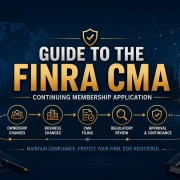
The FINRA CMA – A Comprehensive Guide
 The FINRA Continuing Membership Application — commonly called the CMA, or a “1017 application” — covers most of the consequential changes a broker-dealer can make after becoming a FINRA member. A change in ownership. A material change in business operations. The acquisition or transfer of substantial assets. A merger. A change in control. Each of these requires FINRA approval, and most require a CMA.
The CMA process can be straightforward when handled properly. It can also be slow, expensive, and full of surprises when it isn’t. The difference usually comes down to how well the applicant understands what FINRA is actually evaluating, and how cleanly the application addresses those concerns.
This guide covers the CMA process from the perspective of someone who spent twenty years at FINRA — including service as the South Region Director — and now advises firms through these filings from the outside. Over thirty years handling CMA applications from both sides of the table has provided plenty of opportunity to see what works and what doesn’t. These patterns are worth understanding if you are contemplating filing a CMA.
What a CMA Is — and When You Need One
The CMA is the application a FINRA member files when it proposes certain changes to its ownership, control, or business operations. The rule is FINRA Rule 1017. The principal events that trigger a CMA, or in some cases a mandatory Materiality Consultation under Rule 1017, include:
- A merger of the member with another firm, with certain exceptions related to NYSE members
- A direct or indirect acquisition by the member of another member firm
- A direct or indirect acquisition or transfer of 25% or more of the member’s assets, or any asset, business, or line of operations that generates 25% or more of the member’s earnings (measured on a rolling 36-month basis), unless both the seller and acquirer are members of the New York Stock Exchange, Inc.
- A change in the equity ownership or partnership capital of the member that results in one person or entity directly or indirectly owning or controlling 25% or more of the equity or partnership capital
- A material change in business operations as defined in FINRA Rule 1011(m)
If the change falls within one of the CMA categories, the application is required — even if the change itself feels minor. If the matter falls within one of the mandatory Materiality Consultation categories, the firm must obtain FINRA’s view before proceeding.
One important caveat. In 2020, FINRA expanded the cases in which a CMA-like review is required. Under FINRA Notice 20-15, certain transactions that would normally fall below the 25% threshold, and certain associations involving specified-risk individuals, now require a Materiality Consultation even when a full CMA may not otherwise be required. More on that below.
Material Change in Business Operations
Of the five triggers above, “material change in business operations” is the one most frequently misunderstood. FINRA defines the term in FINRA Rule 1011(m). The rule provides that the term “includes, but is not limited to” three categories:
- Removing or modifying a membership agreement restriction
- Acting as a market maker, underwriter, or dealer for the first time
- Adding business activities that require a higher minimum net capital under SEC Rule 15c3-1
That definition looks narrow. It isn’t.
The phrase “includes, but is not limited to” is where much of the heavy lifting starts. FINRA has consistently treated other business changes as material in practice — adding a new product line, expanding from retail to institutional (or vice versa), opening branch offices in significant numbers, taking on a new clearing arrangement, beginning municipal securities or options business, or moving into business lines with different supervisory or operational risks. None of these are explicitly named in FINRA Rule 1011(m), but they have been treated as material in CMA reviews.
And the analysis isn’t always consistent. I’ve seen FINRA treat the addition of mutual funds as a business line as not material in one case and as material in another. Facts and circumstances matter. So does the specific reviewer, the firm’s history, and the surrounding context. This makes the “is it material?” question genuinely hard for applicants to answer on their own.
Because the consequences of not filing when one was required can be severe — including disciplinary action, retroactive review of the change, and potential restrictions on the firm — most experienced practitioners recommend a Materiality Consultation when the answer is unclear.
The Materiality Consultation Process
FINRA has formalized a process called the Materiality Consultation for exactly this question. A member firm describes the proposed change in writing to FINRA’s Membership Application Program (MAP) staff, who then evaluate whether the change is material under FINRA Rule 1011(m) and respond in writing.
The process typically takes about 30 days, although lately I have seen this time frame reduced. FINRA’s response will say one of three things: yes, this is material and a CMA is required; no, this is not material and you can proceed without a CMA; or this isn’t quite the right category but here’s what we think you should do.
There are tradeoffs to the Materiality Consultation approach. Once you ask, you’re on notice. If FINRA says the change is material, you cannot then claim later that you didn’t know — “asking forgiveness rather than permission” is off the table. On the other hand, if FINRA says the change is not material, you have documentation that protects you against any future second-guessing.
For changes where the answer is genuinely ambiguous, the Materiality Consultation is usually worth doing. The protection of having a written response in your file outweighs the risk of confirming materiality. And, if in fact the change is material and will require a CMA, it is better to know that up front than on the next exam or on the other end of an enforcement action.
The Safe Harbor Expansion: When You Don’t Need a CMA
FINRA recognizes that members will want to grow without filing a CMA for every increase in personnel or every time they open a new branch office. For this reason, FINRA created the Safe Harbor for Business Expansion. The mechanism is FINRA IM-1011-1.
The Safe Harbor allows expansion of the number of associated persons involved in sales and the number of branch offices without triggering the CMA requirement, provided the firm qualifies. For associated persons:
- Firms with 1 to 10 associated persons in sales: 10 additional persons in any rolling 12-month period
- Firms with 11 or more associated persons in sales: 10 additional persons or a 30% increase, whichever is greater, in any rolling 12-month period
For branch offices:
- Firms with 1 to 5 branch offices: 3 additional offices in any rolling 12-month period
- Firms with 6 or more branch offices: 3 additional offices or a 30% increase, whichever is greater, in any rolling 12-month period
There’s also a provision for market-making expansion, though few firms are pursuing that today.
Two conditions limit Safe Harbor eligibility. First, the firm cannot have a disciplinary history, which IM-1011-1 defines narrowly — a finding of a violation in the past five years involving specific enumerated rules (statutory disqualification provisions, certain anti-fraud rules, certain customer protection rules, supervisory failure findings, and similar). The list is specific. Many regulatory findings don’t disqualify a firm from the Safe Harbor.
Second, the firm’s membership agreement cannot contain a specific restriction on the number of personnel or branches. If your membership agreement says “no more than 25 registered representatives” and you want to add more, you can’t use the Safe Harbor — you have to file a CMA (or, more likely, a Membership Agreement Change) to remove or modify the restriction first. It is important to differentiate a restriction from a business activity. One restricts the firm to a maximum number of representatives and the other serves as a baseline when the firm starts. It is not unusual for a FINRA Membership Agreement to state that a firm was approved to operate with, for example, 10 registered persons and 3 branch offices. However, this is not a restriction. It’s just a baseline.
And FINRA Notice 20-15 introduced another limitation. A member can no longer use the Safe Harbor if the expansion would include one or more associated persons in sales who have a covered pending arbitration claim, an unpaid arbitration award, or an unpaid settlement. In those cases, a Materiality Consultation must be filed before the expansion proceeds, even if the expansion would otherwise have qualified for the Safe Harbor.
The Safe Harbor remains useful. Just understand its limits before relying on it.
Asset Transfers and Acquisitions
Among the most common CMA filings are those tied to asset transactions — broker-dealers selling all or part of their business, or acquiring assets from other broker-dealers. The trigger is FINRA Rule 1017(a)(3): a CMA is required for direct or indirect acquisitions or transfers of 25% or more in the aggregate of the member’s assets, or any asset, business, or line of operations that generates revenues comprising 25% or more in the aggregate of the member’s earnings, measured on a rolling 36-month basis, unless both the seller and acquirer are members of the New York Stock Exchange, Inc. And I often get the question, “should I buy a broker-dealer or file a new member application?” I have written a separate piece on that called FINRA Application Process: Buy or Apply which you can read for more details if that is a decision you are facing.
FINRA cares deeply about asset transactions because of a specific concern. When a broker-dealer sells substantially all its assets, the owners receive proceeds. The customers — who may have pending or future arbitration claims — may be left with no operational entity from which to recover. FINRA’s rules give it authority to refuse approval of a transaction that leaves customers in this position.
That concern shapes the entire CMA review for asset transactions. FINRA will scrutinize:
The seller’s outstanding liabilities. Pending arbitration claims, unpaid awards, customer complaints, regulatory matters, and any other obligations that customers may need to recover against.
The seller’s plan for satisfying those liabilities after the sale. Cash reserves, insurance, escrow arrangements, ongoing operations, or other mechanisms.
The buyer’s relationship to the seller’s customers and obligations. Whether the buyer is assuming any of the seller’s liabilities, and on what terms.
This is where the FINRA CMA Arbitration Plan comes in.
The CMA Arbitration Plan
When an asset transfer involves a seller with pending arbitration claims or unpaid awards, FINRA will typically require an Arbitration Plan as part of the CMA. The Arbitration Plan is a written document — not a form, not a template — that describes how the seller will satisfy current and future customer claims after the asset sale closes.
The Plan must address specific elements. FINRA wants to see:
An inventory of current claims. All pending arbitrations, lawsuits, unpaid awards, unpaid settlements, customer complaints, and other potential claims, with a clear status of each.
A funding mechanism. How the seller will satisfy each claim. This may involve cash reserves, insurance proceeds, an escrow arrangement using sale proceeds, or some combination. FINRA wants specifics — not vague promises about future ability to pay.
An accounting of sale proceeds. How the proceeds from the asset sale will be allocated. FINRA’s concern is that proceeds will be distributed to principals before customer claims are satisfied. The Plan needs to show otherwise.
A timeline. When claims are expected to resolve, and how the funding mechanism aligns with that timeline.
For transactions involving substantial outstanding claims, the Arbitration Plan is one of the more difficult documents to get right. Reasonable minds can disagree about what’s adequate. The right size of an escrow, the right duration, the right release conditions — these are negotiated between the parties and FINRA, often through multiple iterations.
A well-prepared Arbitration Plan can move a CMA forward quickly. A poorly prepared plan can stall the application for months or result in denial.
The 2020 Amendments: Arbitration Claims, Unpaid Awards, and Materiality Consultations
FINRA Notice 20-15 announced several significant changes to the MAP rules. The amendments were designed to strengthen the membership application process where applicants, members, or associated persons have covered pending arbitration claims, unpaid arbitration awards, or unpaid arbitration settlements. The practical point is simple: arbitration exposure can materially affect whether a new member application, CMA, business expansion, ownership change, or asset transfer can proceed.
New member applications. For NMAs, the amended rules created a rebuttable presumption of denial when the applicant or its associated persons are subject to covered pending arbitration claims, unpaid arbitration awards, or unpaid arbitration settlements. An applicant may rebut the presumption, but it must do so with specific evidence showing that it can satisfy the claims, awards, or settlements and that the proposed firm can meet the Rule 1014 standards for admission.
Continuing membership applications. The analysis is different for CMAs. FINRA expressly stated that the presumption of denial for a covered pending arbitration claim does not apply to an existing member firm filing a CMA. That does not mean pending claims are irrelevant. FINRA will still consider pending claims, unpaid awards, unpaid settlements, and related facts when evaluating whether the member can satisfy the Rule 1014 standards as applied to the proposed change. But the pending-claim presumption applicable to NMAs does not apply in the same way to CMAs.
Unpaid awards and settlements during CMA review. CMAs involving unpaid arbitration awards or unpaid arbitration settlements require particular care. FINRA may require a firm to demonstrate the ability to satisfy those obligations and may require specific, enforceable funding arrangements. Depending on the transaction, this may include escrow arrangements, insurance coverage, clearing deposits, guarantees, reserve funds, or retention of sale proceeds. Vague assurances about future ability to pay are not enough. This is where a well-supported arbitration plan can be particularly helpful.
Mandatory Materiality Consultations. The 2020 amendments also added mandatory Materiality Consultation requirements for certain transactions that might otherwise fall below the normal CMA thresholds. Under current Rule 1017, a member must seek a Materiality Consultation before certain asset transfers or business expansions involving a covered pending arbitration claim, unpaid arbitration award, or unpaid arbitration settlement if the transaction is not otherwise subject to a CMA. FINRA then determines whether the member may proceed without a CMA or must file a CMA and obtain approval before effecting the change.
Specified-risk individuals. The amendments also require a Materiality Consultation in certain circumstances when a natural person seeks to become an owner, control person, principal, or registered person of the member and has, within the prior five years, one or more final criminal matters or two or more specified risk events, and the member is not otherwise required to file a CMA.
The practical effect is that arbitration exposure and specified-risk events now require earlier analysis in the CMA and Materiality Consultation process. CMA applicants should identify these issues before filing, decide whether a CMA or Materiality Consultation is required, and prepare a record that shows how customer claims, awards, settlements, and related risks will be addressed. Waiting for FINRA to discover the issue usually slows the review and weakens the firm’s position.
Corporate Conversions and Redomestications
One area that surprises a lot of applicants involves corporate conversions — converting from a corporation to an LLC, for example — and redomestications, where the entity is moved to a different state.
The legal mechanics matter here, and they vary by state. Some states (Florida, for example) permit a statutory conversion in which the converted entity is deemed to be the same entity as the original. Other states (New York is the most commonly cited example) do not permit statutory conversion of a corporation into an LLC; instead, you must form a new LLC and merge the old corporation into it. These differences have significant regulatory consequences.
The SEC staff has addressed succession issues in guidance for registered investment advisers, distinguishing between a succession by amendment and a succession by application. Although that guidance was issued in the adviser context, the same basic regulatory concern applies to broker-dealers: a registrant cannot assume that a corporate conversion, redomestication, merger, or restructuring is merely a housekeeping change. For broker-dealers, the specific rule is Exchange Act Rule 15b1-3, which addresses registration of a successor broker-dealer.
In general, when one broker-dealer succeeds to and continues the business of a registered broker-dealer, the predecessor’s registration may remain effective as the successor’s registration if the successor files Form BD within 30 days after the succession and the predecessor files Form BDW. The rule also provides a narrower amendment path when the succession is based solely on a change in date or state of incorporation, form of organization, or composition of a partnership.
The practical distinction is important. Some restructurings can be handled through an amendment when the registered business remains substantively the same and only the legal form, state of organization, or similar organizational detail changes. Other restructurings may require a successor application and withdrawal filing sequence. If the wrong path is used, the firm can create a registration gap or a FINRA membership issue. That’s a problem you don’t want.
FINRA may treat a redomestication or conversion as a material change under FINRA Rule 1011(m), or may ask the firm to address the issue through the Materiality Consultation process, particularly when the substance of the entity is not changing. Whether to file a CMA, pursue a Materiality Consultation, or handle the matter through SEC/FINRA registration amendments depends on the specific facts.
The point here: what looks like a simple legal restructuring can result in the loss of a broker-dealer’s registration if it isn’t planned and executed properly. Sequence matters. Documentation matters. State law, SEC registration rules, and FINRA’s review all have to align. I always encourage clients to involve qualified legal counsel for the corporate side of these transactions when we handle the regulatory side.
The CMA Application Process: Timeline and Key Milestones
The CMA process mirrors the NMA process in structure. Under its rules, FINRA generally has 180 days from the date a substantially complete application is filed to issue a decision. This may be extended under certain circumstances. Within that 180-day window, the timeline typically looks like:
Days 1-30: Substantially complete review. FINRA examines the application package and determines whether it contains enough information for meaningful review. If not, the applicant has a brief period to cure the deficiency or the application is rejected.
Days 30-60: First information request. Once the application is accepted as substantially complete, FINRA assigns an examiner who reviews the package and issues a written request for additional information. This typically arrives within 30 days of acceptance.
Days 60-120: Applicant response, follow-up, and possible membership interview. The applicant generally has 30 days to respond to an information request, unless FINRA agrees to a different date. After review, FINRA may issue a second request, and complex CMAs may involve three or more rounds of questions. FINRA may also require a membership interview, particularly in ownership-change, control-change, asset-transfer, or otherwise substantive applications.
Days 120-180: Decision and membership agreement. FINRA issues a written decision and, if approved, a Membership Agreement reflecting the approved changes and any restrictions. The applicant has 25 days to return the executed agreement.
Whether the process completes in 90 days, 150 days, or pushes against the 180-day limit depends largely on the applicant. Applications that are thorough, internally consistent, and responsive to FINRA’s questions move quickly. Applications that arrive thin and require multiple rounds of clarification don’t.
Substantially Complete Review
Before FINRA’s 180-day clock starts, the application must pass the “substantially complete” gate. Under FINRA Rule 1017(d), FINRA has 30 days from receipt of a CMA to determine whether the application is substantially complete.
The term “substantially complete” isn’t defined precisely in the rules. In practice, FINRA is generous on this — they tend to push applicants to cure rather than reject outright. But the rejection authority exists, and when an application is rejected as substantially incomplete, the consequences are real:
- The application is deemed never to have been filed
- FINRA refunds the application fee less $500
- FINRA provides written reasons for the rejection
- The applicant must re-file with a full application fee if it chooses to proceed
Even applications that are not rejected outright can run into serious issues if substantial revision is required. The first information request from FINRA often reflects the quality of the initial submission. A thin application generates a long, demanding request letter. A thorough application generates a shorter, more focused request — and a faster path to decision.
The Membership Interview
Unlike an NMA, a CMA does not always involve a membership interview. FINRA may require one, however, and interviews are more common in ownership-change, control-change, asset-transfer, and other substantive CMAs where MAP staff wants to hear directly from the firm’s principals or proposed owners.
Under FINRA Rule 1017(g), the Department may require the applicant to participate in a membership interview within 30 days after the filing of the application or, if FINRA requests additional information, within 30 days after the applicant files the additional information. FINRA must provide at least seven days’ written notice of the interview, unless the parties agree to a shorter or longer period or a different method of service.
The interview is not merely a formality. During the interview, FINRA reviews the application and the considerations that will govern its decision under Rule 1017(i). FINRA must also provide the applicant with any information or document obtained from CRD or another source, other than the applicant, on which FINRA intends to rely in making its decision. If FINRA receives that information after the interview, or later decides to rely on it, FINRA must provide it to the applicant with an explanation.
For applicants, the practical point is simple: treat the membership interview as part of the evidentiary record. The participants should understand the proposed transaction, the business plan, the supervisory structure, the financial assumptions, any disclosure or arbitration issues, and the specific reasons the firm believes it satisfies the Rule 1014 standards as applied through Rule 1017. A poorly prepared interview can create questions that were not otherwise problems. A well-prepared interview can help close the gap between the written application and FINRA’s comfort with the proposed change.
Interim Restrictions on Changes of Ownership or Control
For CMAs involving a change of ownership or control specifically, FINRA Rule 1017(c)(1) creates a particular dynamic. The application must be filed at least 30 days before the change is effected. The member may effect the change during the pendency of the application and before a final decision is issued, but FINRA may impose interim restrictions, including restrictions that effectively prevent the transaction from closing until the application has been approved.
FINRA’s objection comes in the form of “interim restrictions.” These are conditions FINRA can impose during the pendency of the application, which may include a prohibition on effecting the transaction until the application has been fully reviewed and approved.
Interim restrictions are typically imposed when FINRA makes a preliminary assessment that the applicant may not meet one or more of the FINRA Rule 1014 standards. If FINRA doesn’t object within the 30-day window, that’s not approval — it’s permission to proceed at the applicant’s own risk.
The risk matters. If the applicant effects the transaction and FINRA later denies the CMA, the applicant has limited options: file a new application, unwind the transaction, or file Form BDW and withdraw from FINRA membership. None of those is a good outcome.
For changes of ownership where the applicant is confident the transaction will be approved, proceeding before the formal decision can be a reasonable choice, especially when there are significant time pressures. For changes where there’s any uncertainty, waiting for approval is the safer path.
CMA Fees and Fee Waivers
FINRA began charging CMA application fees in 2012, after years of processing CMAs without recovering its costs. The current fee schedule, set out in FINRA Regulatory Notice 12-32 and Section 4(i)(3) of Schedule A of the FINRA By-Laws, is tiered based on firm size and the type of CMA.
For small firms (1-150 registered persons), fees range from $5,000 to $15,000 depending on the specific tier. For large firms, fees can reach $75,000. Asset transfers have their own fee structure — for small firms, the asset transfer fee is typically a flat $5,000.
FINRA also recognized that some CMAs involve less staff review than others, and in 2013 issued Regulatory Notice 13-11 describing circumstances in which fee waivers may be granted. The guidance identifies two main categories:
First, changes that don’t make day-to-day changes in business activities, management, supervision, assets, or liabilities — for example, a legal structure change from corporation to LLC, the addition of a holding company, or a change in the percentage ownership of existing owners without disclosure or disciplinary issues.
Second, asset transfer applications where there are no pending or unpaid customer-related claims, or where claims exist but an escrow has been established to satisfy them.
The waiver criteria are narrow, but FINRA has granted waivers in other circumstances as well. The waiver request should be uploaded to the FINRA Gateway with the application itself, in the section covering Standard 1, with a written justification for why the waiver is appropriate.
Protecting Client Information When Closing or Transferring a Broker-Dealer
One area that often gets less attention than it deserves in CMA work is customer data protection under Regulation S-P. When a broker-dealer winds down operations, sells substantial assets, or transfers customer accounts, Regulation S-P obligations are triggered — and getting them wrong has led to public enforcement actions.
The core obligations:
Privacy notices. Regulation S-P requires broker-dealers to deliver a privacy notice when an account is opened and annually thereafter (with some exceptions). The notice must describe what data the firm collects, how it uses that data, and how it protects the data.
Opt-out provisions. If the broker-dealer shares customer information with non-affiliated third parties, the notice must include an appropriate description of that sharing along with an opt-out provision allowing customers to prevent that sharing. The form of the opt-out is specified by the rule — simply providing an address for customers to write to is not adequate.
The opt-out requirement is particularly significant for firms operating in the independent representative channel, where departing representatives’ practice is often to take customer data with them. When a broker-dealer closes or sells assets, any provision of customer information to third parties — including the acquiring firm — must comply with the Regulation S-P notice and opt-out requirements. Customers must be given the requisite notice and 30 days to opt out before the transfer. There are also state laws that limit sharing more strictly, and in some circumstances require the affirmative consent of the client.
Safeguarding and disposal. Rule 30 of Regulation S-P specifies requirements for safeguarding and disposing of customer records. Records containing customer information — account numbers, holdings, dates of birth, and similar — must be disposed of using secure methods. And disposal cannot violate the records retention requirements in SEA Rule 17a-4.
The places customer data ends up are often surprising. Hard drives and servers. Backups. Old laptops. Email archives. When a broker-dealer closes, all of these need to be addressed, not just the obvious and primary systems.
Breach notifications. The 2024 amendments to Regulation S-P also require notification of affected individuals whose sensitive customer information was or is reasonably likely to have been accessed or used without authorization. Firms must keep this in mind in the context of broker-dealer closures, acquisitions, and asset transfers.
The penalty for Regulation S-P failures during a closure isn’t theoretical. FINRA and the SEC have brought significant enforcement actions in this area, sometimes against individuals personally. The actions matter — regulators take customer privacy seriously, and they will pursue these cases.
Getting Faster Approval
The CMA process has at times earned a reputation for being slow. Some of that reputation is fair. Some of it isn’t.
FINRA’s rules generally require it to issue a decision within 180 days for substantially complete applications. The reality is that many CMAs are completed in 90-120 days, and some in less. FINRA has invested in process improvements over the years — the FINRA Gateway online system, expedited review options for certain applications (a/k/a “fast track”), more responsive staffing — and these have made a real difference. When applications arrive in good shape, FINRA staff is responsive and moves the work along.
The patterns I see in CMAs that resolve quickly:
The application is substantially complete on day one. Every required document is included. The narrative is internally consistent. The financial information matches the business description. The supervisory plan addresses the actual proposed business.
Responses are fast. FINRA gives applicants 30 days for responses. Applicants who respond in 15-20 days with complete answers significantly compress the overall timeline. Applicants who use the full response period for every round can easily add months to their own timeline.
The applicant takes pre-filing meetings seriously. For more substantive CMAs, requesting a pre-filing meeting with MAP staff can surface issues before they become written deficiencies. This is particularly valuable for novel transactions or for applicants with disciplinary history.
The scope of the application matches the actual proposed change. Applicants sometimes try to include every potential future change in a single CMA, hoping to avoid filing again later. This typically backfires — broader scope means broader review and more questions. A focused CMA covering only the immediate change tends to move faster than one trying to cover speculative future activities. Further, FINRA must evaluate the application that is presented and the plans must be real. Hypotheticals, digital applications that are not ready, and business plans that are not sound only serve to slow down the process.
FINRA has also created an expedited review program — sometimes called “fast track” — for certain applications. Eligibility is discretionary. Applications that qualify tend to be straightforward in scope, involve experienced principals, and lack disclosure history. For applicants who fit that profile, raising fast-track treatment in a pre-filing meeting is worth the conversation, but only FINRA can grant it.
When the CMA Goes Sideways
Not every CMA proceeds smoothly. A few patterns worth recognizing:
The CMA gets rejected as substantially incomplete. As discussed above, this means the application is treated as never filed, with all the associated consequences. The fix is to develop the application further and re-file. The harder question is figuring out what FINRA wanted that wasn’t there — and why it was not provided in the first place.
Interim restrictions get imposed. For changes of ownership, this effectively pauses the transaction during the application review. There are risk factors that increase the likelihood of such a pause and these should be considered in advance, addressed in a pre-filing call, and covered in the application itself.
The applicant is subject to a presumption-of-denial. Under the 2020 amendments, this is more common when arbitration exposure exists. Overcoming the presumption requires substantive documentation and can require restructuring of the proposed transaction.
FINRA denies the application. The applicant has rights under FINRA Rule 1015 to seek review before the National Adjudicatory Council (NAC), and beyond the NAC may apply for SEC review under FINRA Rule 1019. An applicant can also withdraw and refile a new application that addresses the deficiencies identified in the denial.
For applicants facing any of these scenarios, the path forward depends on the specifics. Each scenario has a different set of considerations and a different best response.
Working with a CMA Consultant
Most substantive CMAs benefit from regulatory consulting assistance, particularly when the application involves a change of ownership, an asset transfer, or any matter requiring an Arbitration Plan or response to the rebuttable presumption. The reasons are practical:
The rules are complex and intersect in ways that aren’t obvious. The FINRA Rule 1017 framework, the FINRA Rule 1011(m) materiality definition, the FINRA Rule 1014 standards, the Materiality Consultation process, the Safe Harbor provisions, the 2020 amendments, the SEC succession guidance, and the Regulation S-P obligations all interact. Knowing how they fit together comes from experience.
FINRA’s expectations are shaped by what FINRA has seen work and fail in past applications. Applicants approaching their first CMA don’t have that context.
The cost of mistakes is meaningful. A rejected application can cause several months of delay. A denied application can effectively terminate a planned transaction. The investment in qualified consulting assistance often pays for itself in reduced risk and faster approval.
The right consultant for a CMA brings substantive FINRA experience, familiarity with the specific type of transaction at hand, and the practical judgment to anticipate what FINRA will want to see. For asset transactions specifically, experience with Arbitration Plans and the negotiation around escrow arrangements is essential.
FirstMark and the CMA Process
FirstMark Regulatory Solutions handles CMAs for FINRA member firms across the full range of transaction types — material changes in business operations, ownership changes, asset transfers, mergers, corporate conversions, and the related Materiality Consultations. Mitch Atkins, the firm’s principal, spent twenty years at FINRA including service as the South Region Director, where he oversaw the CMA function for the region and later coordinated applications with the centralized MAP Group in New York. With over thirty years in the securities industry, his experience covers both sides of the process.
For more information about FINRA CMA Applications, see our CMA Services Page. For questions about a specific CMA or to discuss a prospective transaction confidentially, contact Mitch Atkins, Principal of FirstMark Regulatory Solutions, at (561) 948-6511.
