
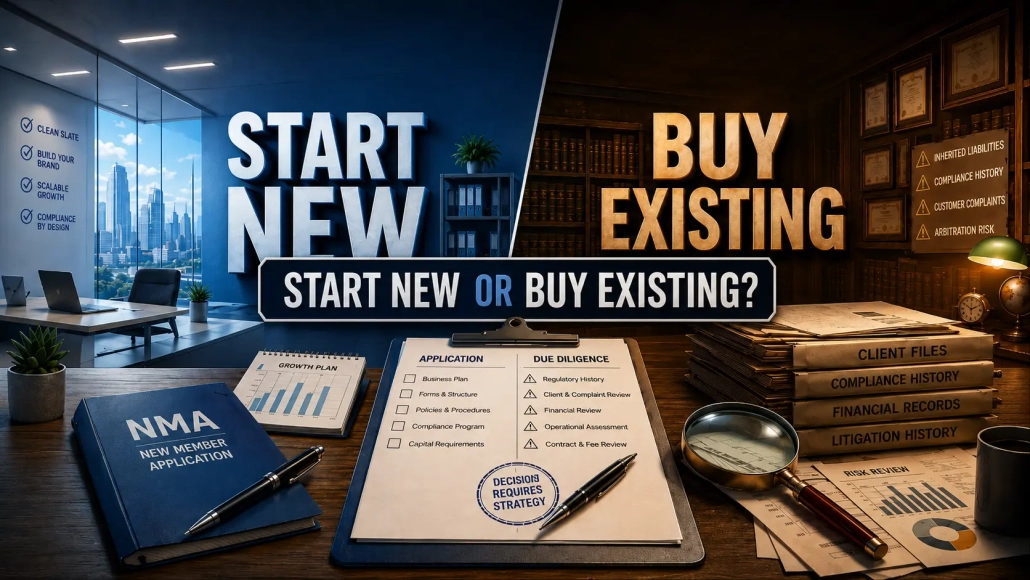
FINRA Application Process: Buy or Apply

One of the first decisions a prospective broker-dealer owner faces is whether to start a new firm or buy an existing one. The question sounds simple. The answer rarely is.
I’ve reviewed hundreds of broker-dealer purchase and sale transactions over the years — sometimes as a FINRA executive evaluating them, more recently as a consultant guiding clients through them. The patterns are consistent enough to be worth writing about. And for prospective owners weighing this decision, the strategic differences between the two paths matter much more than the surface-level financial math suggests.
A Broker-Dealer Is Not an Ordinary Business
A broker-dealer is unlike almost any other business you might buy. It operates under the rules of FINRA, the SEC, the MSRB, SIPC, fifty state securities regulators, the Bank Secrecy Act, and a long list of related federal and state requirements. Conduct that would be unremarkable in another industry — undocumented agreements, informal supervisory practices, lax recordkeeping — carries real regulatory consequences for a broker-dealer.
More importantly, when you buy a broker-dealer, you buy everything that came with it. Known liabilities. Unknown liabilities. Regulatory history. Customer relationships. Supervisory deficiencies. Prior arbitration awards. Conduct issues from associated persons going back years. When you sign the Form BD and the Forms U4, you place yourself within FINRA’s jurisdiction not only for what happens going forward but, in some respects, for what happened before.
And FINRA arbitration is its own consideration. Broker-dealers and their associated persons are subject to mandatory arbitration of most disputes, and arbitration claims can be filed years after the underlying conduct. A firm that looks clean on paper today may have arbitration claims developing that won’t surface for another two or three years. By the time the new owner gets the notice, the prior owners are long gone, the accounts have been integrated, and the customer is looking to the current registered entity for recovery.
The regulation is rigorous for a reason. Members of the public entrust their savings to broker-dealers, and the framework exists to protect that trust. Anyone entering this industry as an owner needs to take that seriously from the outset — not as an inconvenience to navigate around, but as a feature of the business.
Two Paths Into the Industry
The question is whether to enter the industry by filing a New Member Application (the NMA) with FINRA — building a new broker-dealer from scratch — or by acquiring an existing FINRA member firm and operating under its membership.
Each path has real advantages.
A new member application produces a clean firm. The membership starts on the application’s filing date. There is no prior conduct, no inherited supervisory history, no pending arbitration claims, no prior customer base whose accounts were handled under someone else’s procedures. The entity exists in regulatory terms exactly as you build it.
An acquisition produces an operating firm. The membership is already approved. There may be existing customer accounts, registered representatives, clearing relationships, technology infrastructure, and operational systems. Sometimes these unique elements make it worth pursuing an acquisition.
While the surface math may favor acquisition, the deeper analysis often favors starting new.
The Case for Starting New
In my experience, starting a new broker-dealer is usually the cleaner path — and frankly, for most prospective owners entering the industry without a specific operational reason to acquire a target, it’s the right one.
What you don’t inherit when you start new:
Prior conduct. You do not inherit conduct of previous owners or associated persons — supervisory failures, customer complaints, conduct issues, regulatory findings, etc. The clean slate is genuinely clean.
Hidden liabilities. Many broker-dealer liabilities don’t surface immediately. Arbitration claims can be filed years after the underlying conduct. Regulatory inquiries may develop into formal actions over time. Tax issues, employment claims, contractual disputes with vendors — these can take months or years to materialize. An acquired firm carries all of it, whether disclosed at closing or not. I have even seen previously unknown judgments pop up against recently acquired broker-dealers for activities of prior prospective buyers. The possible hidden liabilities are endless. And it is important to remember that typically, the only recourse the buyer has is an indemnification agreement by the seller. I have seen instances, particularly with small firms, where the seller in these circumstances refuses to pay or claims to be out of money.
Someone else’s supervisory system. Inherited written supervisory procedures, compliance programs, AML programs, and operational systems were built for the prior owner’s business. Adapting them to your business is often harder than building new ones from scratch — especially if (as is common) the inherited procedures were thin or templated to begin with.
Someone else’s people. An acquired firm’s registered representatives and operations staff came with the firm. Some may be excellent fits; others may not. A new firm lets you build the team you actually want.
The cost is time and capital. The NMA process typically runs 9 to 12 months. During that time the firm has no revenue and bears its share of professional fees and pre-operating costs. For someone with adequate capital and a defined business plan, that’s a manageable tradeoff. For someone trying to enter the industry quickly with limited capital, it may not be.
The CMA vs. NMA Myth
Over the years, I have repeatedly heard the myth that a an acquisition CMA is easier than a FINRA NMA. In my experience, this is almost always false. In fact, I often observe the opposite. I have seen CMA acquisition reviews take many months longer than a new member application because the applicant attempts to utilize the existing broker-dealer’s policies, procedures, systems, and personnel for a new busienss model that is incongruent.
Make no mistake – FINRA will review everything in an acquistion that it would normally review in a new member application. In some cases there are historical regulatory issues with the acquisition target that complicate the CMA far more than would be the case with a clean NMA. Simply stated, an acquisition can have many more issues and be subject to much more scruntiny than a new member application.
When an Acquisition Makes Sense
Acquisitions are sometimes the right call. The conditions that make them work:
The target has genuine strategic value — a specialized client base, a unique geographic presence, a particular line of business, or an established operational platform that would take years to replicate. (Generic “shelf” broker-dealers acquired primarily for the FINRA membership rarely meet this standard, no matter what the seller’s broker tells you.)
Speed to operation is genuinely critical. If business circumstances require operating as a broker-dealer within the next several months, the NMA timeline may not be workable.
The buyer has the resources to do real due diligence. Adequate diligence on a broker-dealer acquisition involves a regulatory consultant, securities counsel, an accountant familiar with broker-dealer financials, and time. Buyers who can commit those resources can meaningfully reduce the inherited-liability risk. Buyers who can’t are buying mostly on faith.
The target’s history is genuinely clean. Some firms — particularly smaller firms that have operated quietly for years with no customer complaints, no regulatory findings, and no associated person issues — present meaningfully lower inherited-liability risk than the industry baseline. These firms exist. They’re just not the typical acquisition target.
When these conditions hold, acquisition can be the right path. When they don’t, it tends to be a path that looks faster than starting new but ends up more expensive and more complex once the inherited issues surface.
The Hybrid Approach
For prospective owners who want some of the benefits of acquisition — particularly a customer base or a registered representative team — without the inherited regulatory exposure, there’s a third path that’s worth understanding.
An existing broker-dealer can acquire specific assets of another broker-dealer — typically customer accounts, registered representative relationships, and operational infrastructure — rather than acquiring the existing firm itself.
The structural benefit is real. The selling firm generally retains its membership through the asset sale and remains responsible for its own pre-sale liabilities. The new entity buys the productive assets without buying the historical exposure.
This approach isn’t free of regulatory process. An asset acquisition still requires FINRA approval under FINRA Rule 1017, which governs continuing membership applications including material changes in ownership and business. More on that below. But the structural separation between the buying broker-dealer and the selling firm’s history is real.
How FINRA Reviews Acquisitions: The CMA Process
Whenever a member firm undergoes a material change in ownership, control, or business — including the sale of substantial assets — FINRA requires a Continuing Membership Application, or CMA, under Rule 1017.
For asset transactions specifically, the trigger is in Rule 1017(a)(3): a CMA is required for direct or indirect acquisitions or transfers of 25% or more in the aggregate of the member’s assets, or of any asset, business, or line of operations that generates revenues comprising 25% or more in the aggregate of the member’s earnings, measured on a rolling 36-month basis. Smaller transactions may not require a CMA, but firms should confirm with regulatory counsel or a CMA expert whether a specific transaction crosses the threshold. Don’t assume.
The CMA process is similar to the NMA process in structure — FINRA reviews the application against substantive standards, may request additional information, conducts an interview if needed, and issues a written decision. But the substantive review is different. In a CMA tied to an asset sale, FINRA looks at the acquiring firm’s readiness to take on the new business, and it also looks at the selling firm: its plans for remaining operations, its outstanding liabilities, and its ability to satisfy obligations to customers and counterparties after the sale closes.
Customer Claims and the Escrow Question
One of the more consequential aspects of FINRA’s CMA review involves outstanding customer claims and the seller’s ability to satisfy them.
FINRA’s concern is straightforward. When a broker-dealer sells substantially all of its assets, the principals receive proceeds from the sale. The firm’s customers — who may have pending or future arbitration claims — may be left with no operational entity to recover against. FINRA’s rules give it authority to refuse approval of a transaction that leaves customers in this position.
The usual mechanism for addressing this is an escrow arrangement. FINRA may require that a portion of the sale proceeds — sometimes a substantial portion — be placed in escrow for a defined period to satisfy current and future customer claims. The size, the duration, and the conditions for release are negotiated between the parties and FINRA on a case-by-case basis.
For sellers, this can change the economics of the transaction significantly. Sale proceeds that the seller expected to receive at closing may be tied up for years. For buyers, the escrow provides some protection — the escrow stands behind customer claims that might otherwise have followed the acquired assets — but the negotiation around escrow size and structure is one of the more contentious aspects of broker-dealer transactions, and reasonable minds can disagree about what’s adequate.
FINRA’s analysis of what constitutes adequate provision for outstanding liabilities is nuanced. It depends on the seller’s specific circumstances: the volume of historical customer complaints, the seller’s litigation and arbitration history, the nature of the products sold and the customer base, the firm’s overall risk profile. Building a defensible escrow arrangement is one of the harder aspects of CMA work for asset transactions.
What to Look at in Due Diligence
If you choose to acquire, the due diligence required for any broker-dealer acquisition is substantial. A few areas that consistently deserve focused attention:
Regulatory history. Pull the target firm’s complete BrokerCheck record. Pull the BrokerCheck records of all current and recent associated persons. Look at the firm’s examination history, regulatory findings, and any disciplinary actions. Patterns matter more than individual events.
Customer complaint history. Review all customer complaints, arbitrations, and litigation involving the firm or its associated persons. The published BrokerCheck history isn’t always complete — ask for internal records of customer complaints, including those resolved before formal filing.
Pending and potential arbitration claims. Identify any pending arbitration claims. Then look harder at the patterns that suggest future claims that haven’t been filed yet: customer turnover, the nature of products sold, the conduct profile of recently terminated associated persons. Future claims often emerge from these patterns. This is one of the greatest single risks there is in an acquisition. You must look for potential claims based on prior activity. This often involves looking back at products sold for the last ten years and anticipatng any future issues related to these sales and the manner of sales.
Supervisory adequacy. Review the firm’s written supervisory procedures, supervisory testing records, and exception reports. Procedures that are thin, generic, or out of date suggest the firm has been operating without adequate supervisory infrastructure — and that usually correlates with higher future liability.
Financial condition. Beyond the standard financial diligence, look at the firm’s net capital history, FOCUS report filings, and any indications of financial stress that might suggest impending issues.
Buyers who skip this diligence often discover the issues after closing — at which point the practical recourse against the sellers is limited and the regulatory liability has transferred to them. The diligence work isn’t optional. It’s the difference between an acquisition that works and one that becomes the buyer’s expensive education.
The FirstMark View
For prospective broker-dealer owners weighing the buy-or-apply decision, the right answer depends on specific circumstances — operational needs, capital available, time horizon, the strategic value of any specific target, and tolerance for inherited risk.
But my view, after analyzing hundreds of these transactions, is that starting new is usually the cleaner path. The clean regulatory slate, the supervisory system built for your actual business, the personnel you’ve selected, the absence of inherited exposure — these are substantial benefits that often outweigh the longer pre-revenue timeline. For buyers who want acquired assets as well, the hybrid approach preserves most of the clean-start benefits while capturing the operational head start.
Acquisitions of existing firms remain the right path under specific circumstances — when the target has genuine strategic value, when due diligence can be done thoroughly, and when the buyer understands and is prepared to manage the inherited-liability risk. Just be honest with yourself about whether those conditions actually hold before you sign anything.
FirstMark Regulatory Solutions handles both New Member Applications and Continuing Membership Applications, including the CMAs that arise in broker-dealer asset acquisitions. For prospective owners considering this decision, an initial conversation usually clarifies the analysis quickly.
For more on the FINRA NMA process, see our complete guide to the FINRA New Member Application. For questions about a specific transaction or to discuss your circumstances confidentially, contact Mitch Atkins, Principal of FirstMark Regulatory Solutions, at (561) 948-6511.